Call us
Power Skiving
Power Skiving | |
Simulation | |
The Power Skiving software simulates the gear manufacturing process of Power Skiving. The software is implemented in a commercial CAD environment which ensures increased accuracy of the simulation. The main functionality includes the calculation of a gear gap and the undeformed chip geometry as well as the cutting forces produced during the process. A crucial parameter of an accurate simulation is a correct cutting tool profile. In power skiving the tool profile depends on the workpiece geometry as well as on the tool inclination angle, known as shaft angle Σ. Thus for each cutting case the tool profile is calculated in the simulation software.
The calculated tool profile geometry is correctly positioned in the 3D space according to the power skiving process kinematics in order to produce the tool trajectory. During the profile positioning. every movement involved in the process is transferred to the cutting tool so as to decrease the complexity of the simulation. The tool trajectory is used in order to calculate the geometry of a gear gap by performing successive cutting passes along the workpiece axis. During the gear gap generation the undeformed chip geometry of each cutting pass is calculated. It is important to mention that each generating tool position used to calculate the gear gap, is contained in the tool trajectory. Thus, each cutting tooth performs the exact same 3D motion resulting in identical chip geometry between different teeth for a same cutting depth. The undeformed chip geometry can be later used in order to calculate the cutting forces produced during the process.
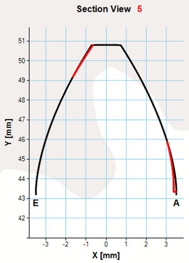
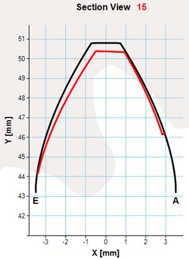
Τ he chip geometry of each cutting pass is identical for every cutting tooth, considering a stable depth of cut. However the chip geometry greatly differs between internal and external gears and it is modified depending on the axial feed of the manufacturing process. In specific, for a same module and cross axis angle, internal gear cutting chips are generally longer than those of external gears. In addition, raising the axial feed of the simulation chips with increased thickness are produced and by increasing the Cross Axis angle of the cutting tool, the chip is generally lengthened. The cutting forces are calculated by sectioning the 3D chip geometry at each revolving position of the tool trajectory. For each cutting section a 2D geometry is produced, which gives valuable information about the chip thickness and total area at the corresponding position. By positioning the cutting section along with the tool geometry, information about the affected tool area as well as the chip thickness along the unrolled cutting edge is extracted.
According the Kienzle-Victor equations, given the process material and cutting speed parameters the cutting forces at a specific cutting section as well as the total forces may be calculated. This is accomplished by separating the 2D geometry into segments and calculating three force components for each elementary segment, based on its area and height. The total forces for each section constitute the total sum of the transformed cutting force components of each segment in the section coordinate system. The total forces of the manufacturing process are produced by transforming the cutting forces of each revolving position to the workpiece coordinate system. In this step of the forces calculation, all teeth engaged in the process should be taken into account, so that the total forces calculation is correct.
Your contact:
|
|
| |